



Published April 22 2021
The capex plans of leading semiconductor companies around the world suggest there is life left in the current tech cycle upswing.
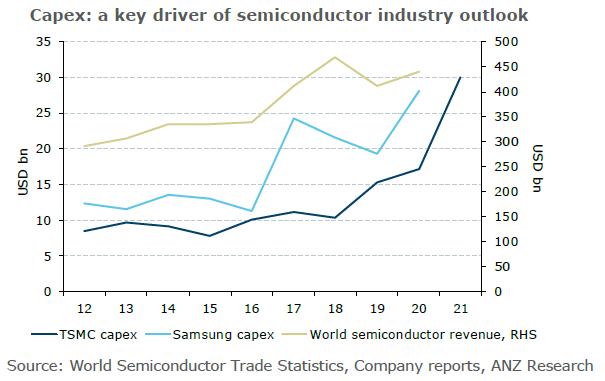
Tech giant Samsung’s capital expenditure rose a massive 45 per cent year-on-year to $US28.1bn in 2020, and industry analysts believe this expenditure will continue through 2021.
Taiwan Semiconductor Manufacturing Company (TSMC) has unveiled a multi-year ramp-up in capex plans, lifting its 2021 capex estimate to $US30 billion. This is part of TSMC’s three-year plan to invest $US100 billion towards chip fabrication capacity expansion.
These two leading producers are likely to account for nearly 43 per cent of worldwide semiconductor industry capex, according to an IC Insights report.
Demand for tech has seen robust growth. Mainland China has emerged as the largest market for new semiconductor equipment, with sales growth of 39 per cent year on year to $US18.7 billion. It outpaced Taiwan ($US17.2 billion) and South Korea ($US16.1 billion) to top the global chip manufacturing equipment market for the first time in 2020.
A shortage of semiconductor chips is also impacting demand-supply dynamics. Industry leaders believe the ongoing semiconductor chip shortage is likely to remain until 2022. Executives at both Intel and TSMC have also alluded to the shortage persisting as demand outstrips supply.
The scale-up in capex comes amid a backdrop of robust tech demand and a shortage of semiconductor chips. As capacity ramps up, Asia’s tech economies are likely to feel the tailwinds in their export demand.
Bansi Madhavani is a Senior Economist at ANZ
This story is an edited version of an ANZ Research report. You can read the original report HERE.