



Indonesia is one of the world’s largest markets for food, beverage and agribusiness (FBA), with almost 300 million mouths to feed. Meeting that demand requires a mix of domestic production, structural imports and complex logistics across thousands of islands.
For FBA producers, processors and investors in Australia, Indonesia is too large and too influential to ignore.
Indonesia sits at the centre of one of the most consequential FBA stories of the coming decades. A bowl of noodles bought from a Jakarta street stall might contain imported wheat, locally grown vegetables, soy-based protein and cooking oil that has already travelled across several islands before it reaches the wok.
That single meal captures how Indonesia feeds itself: a vast domestic market supplied through a mix of local production, global inputs and a distribution system shaped as much by geography and policy as by farming.
With a population of around 280 million people, Indonesia is already the world’s fourth most populous country, adding more than two million people each year as growth continues at roughly 0.8 per cent annually. Urbanisation has advanced steadily, with close to 60 per cent of Indonesians now living in cities, compared with less than 45 per cent two decades ago.
Greater Jakarta — now estimated at more than 40 million people and widely regarded as the world’s largest urban area — concentrates food demand on a scale comparable to entire midsized countries. That scale is reshaping how food is bought, prepared and delivered, shifting purchasing toward supermarkets, convenience stores, delivery platforms and modern foodservice.
For companies and investors looking across the FBA supply chain, Indonesia’s demand is not theoretical. It shows up every day in supermarket volumes, the rapid expansion of foodservice, and sustained import flows across key commodities. The more complex task lies in understanding how that demand is supplied, regulated and converted into reliable returns.
Increasingly influential
Indonesia has long been a significant agricultural exporter, particularly in palm oil, coffee, cocoa and seafood, and it remains a core participant in global commodity markets. Alongside that outward facing role, its domestic food economy has expanded into one of the largest in Asia outside China and India, with internal consumption now playing an increasingly influential role in shaping policy, supply chains and commercial strategy.
Indonesia’s gross domestic product per capita now sits at roughly $A7,500, below developed Asian economies such as Japan or South Korea, but high enough to support discretionary food spending in urban centres. Estimates vary, but 50 to 70 million Indonesians are generally considered middle class, with annual household incomes commonly cited in the $A10,000 to $A30,000 range. This group underpins demand for packaged foods, branded beverages, café culture and meals eaten outside the home.
Food still absorbs close to half of total household expenditure, compared with around 10 to 15 percent in developed markets. That level of food spending shapes consumer behaviour, retail strategy and policy choices.
Food affordability is front of mind, retail strategy remains price sensitive, and consumer behaviour changes gradually rather than abruptly. When incomes rise, spending does not move away from food; it shifts within it. Loose rice becomes packaged rice. Wet markets coexist with supermarkets. App-based delivery platforms extend restaurant access into residential neighbourhoods, particularly among younger, urban consumers.
Indonesia is also one of the world’s largest instant-noodle markets, consuming well over 14 billion servings each year. Brands such as Indomie have become household staples across income groups, illustrating how processed, wheat-based foods have embedded themselves into daily diets despite the absence of any domestic wheat production.
Foundation
Rice remains the foundation of the Indonesian diet, with per capita consumption still around 90 to 100 kilograms per year. That level is broadly comparable to Thailand, lower than Vietnam, where consumption exceeds 140 kilograms per person, and far higher than China or Japan, where rice intake has fallen sharply over time.
In Indonesia, rice consumption has edged down gradually, but it remains central to most meals. Animal protein intake is increasing, but from a low base.
Poultry dominates because it is affordable, widely distributed and consistent with halal requirements. Fried chicken chains, both international and domestic, are now common not only in major shopping centres but also in provincial towns, while poultry features heavily in street food as well as formal retail. Beef consumption remains low by global standards, at less than three kilograms per person per year, rising seasonally around Ramadan and Eid when festive demand meets heightened price sensitivity. Fish continues to provide a substantial share of protein intake, particularly in coastal provinces where supply chains are shorter and prices are often lower than red meat.
Dairy is increasingly shaped by policy as much as by consumer choice. Successive governments have identified milk consumption as a national nutrition priority, embedding dairy into programs aimed at improving childhood health and food security at scale. From a low starting point — with milk consumption still under 20 litres per person per year, compared with roughly 90 litres in Australia and far higher levels in Europe — the structure of demand is changing.
Sweetened milk beverages, yoghurt drinks, powdered milk for children and ice cream have expanded rapidly in urban areas, and Indonesia has become one of south-east Asia’s largest infant formula markets. Domestic milk production supplies only a minority of national requirements, leaving processors reliant on imported milk powders and whey.
Logistical realities
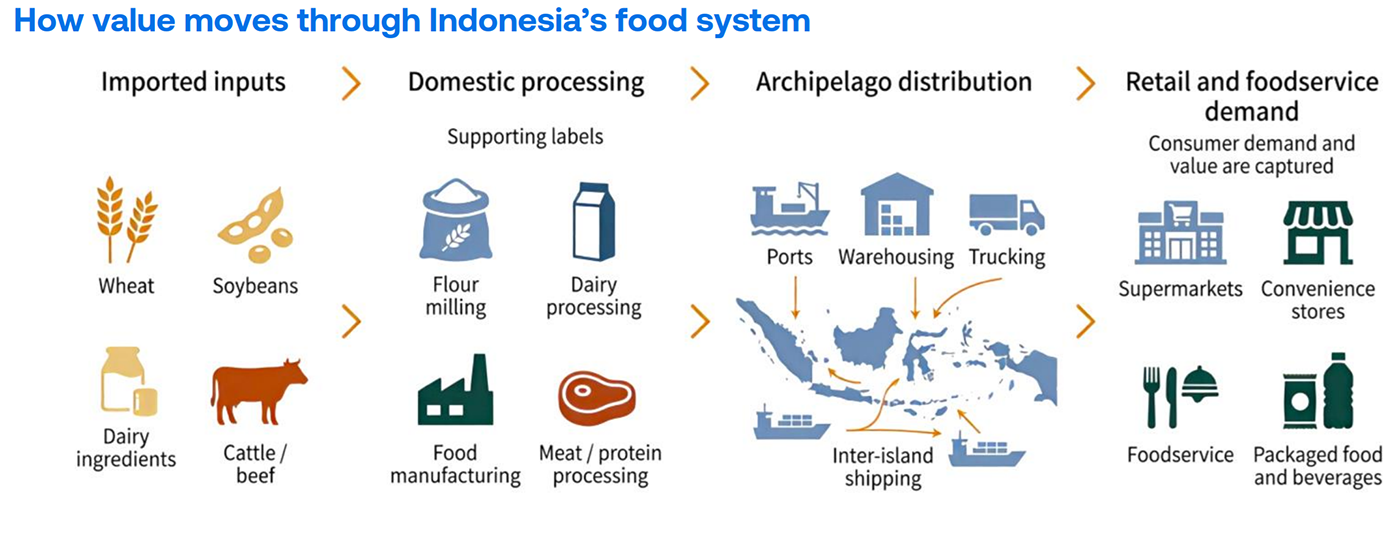
Supplying food across more than 17,500 islands introduces logistical realities few large economies share. Indonesia stretches roughly 5,100 kilometres from west to east, so imported wheat unloaded in Jakarta must still move through domestic transport networks before reaching mills and retailers in other provinces.
Fresh produce grown in one region may travel by sea before appearing in supermarkets elsewhere. Cold storage, port facilities and road infrastructure have improved over time, but coverage remains uneven, particularly outside major urban corridors.
Agricultural production itself remains highly fragmented. In parts of East Java, dairy farmers commonly keep only two or three cows, delivering milk to cooperatives for aggregation. Similar smallholder patterns dominate rice and horticulture.
While Indonesia places strong emphasis on food self-sufficiency, certain imported commodities remain a structural input to the food system. The country imports around 10 to 11 million tonnes of wheat each year, consistently ranking among the world’s largest buyers.
That wheat feeds domestic mills producing noodles, bakery items and snack foods sold through chains such as Alfamart and Indomaret as well as traditional kiosks. During the Russia–Ukraine conflict, global wheat markets were heavily disrupted, yet Indonesian consumption patterns persisted as millers diversified sourcing.
Dairy imports, largely from New Zealand, Australia, the European Union and the United States, support local processing of milk-based beverages and powders. When global dairy prices surged in 2022 and 2023, retail prices rose but import dependence did not diminish. Beef imports from Australia and Brazil supplement domestic cattle supply, particularly during festive periods.
Soybeans from the United States and South America underpin tofu and tempeh production nationwide. During periods of elevated soybean prices, small tofu producers have protested rising costs, a reminder of how directly global commodity markets shape everyday meals.
Relative share
Given wheat is not produced domestically, Indonesia imports around 10 to 11 million tonnes each year to supply flour mills that feed noodle production, bakery goods and a wide range of processed foods consumed daily across the country.
These imports come mainly from Australia, the Black Sea region and North America, with relative shares shifting according to those countries’ harvest volumes, export availability and price competitiveness. In years when Australian crops are large and freight conditions are favourable, exports to Indonesia have reached several million tonnes, reinforcing Indonesia’s position as one of Australia’s most important offshore grain markets.
Beef and cattle trade into Indonesia reflects a similar need to balance reliability of supply, price and policy objectives. Australia remains Indonesia’s principal supplier of live cattle, supporting domestic feedlot operations and wet market supply, while boxed beef imports are sourced mainly from Australia and Brazil. Import volumes are often adjusted by authorities ahead of Ramadan and Eid, when demand rises sharply and retail price sensitivity intensifies.
At times, Indonesia has also approved imports of frozen buffalo meat from India to ease pressure on domestic prices, with this trade playing a role in managing affordability rather than providing a consistent base of supply.
Dairy imports are concentrated in ingredients rather than finished products, with Indonesia sourcing milk powders and whey to support domestic beverage, infant nutrition and processed food manufacturing. New Zealand is a major supplier of milk powders, while Australia, the European Union and the United States provide a range of dairy ingredients across different specifications and product uses including milk powders for beverages, whey and lactose for infant nutrition, and butterfat for processed foods.
Soybeans are imported largely from the United States and South America, particularly for tofu and tempeh production, while raw sugar is commonly sourced from Brazil and Thailand.
Poultry feed ingredients and oilseed meals link Indonesia to global grain exporters, with soybean meal, corn and other protein and energy inputs sourced largely from the United States, South America and parts of the Black Sea region. These products are used primarily in poultry feed, reflecting the scale of the domestic chicken sector, but they also support aquaculture and, to a lesser extent, dairy and other livestock production as feed demand expands.
For Australia, Indonesia represents a long-standing destination for wheat, beef and dairy products, while for exporters in Europe, North America and the region it is one of Southeast Asia’s largest food import markets, with access shaped by pricing, product specifications and regulatory settings rather than distance alone.
Reconstituted
For many food and agribusiness participants, the commercial story begins once commodities enter Indonesia. Wheat, milk powder and soybeans arrive as inputs, but margins are largely captured once those ingredients are milled, processed and branded for domestic consumers.
Imported wheat becomes Indomie noodles, packaged bread and biscuits sold across urban and rural markets. Milk powders are reconstituted into sweetened beverages and café style drinks consumed in shopping centres and neighbourhood outlets.
A KFC restaurant in Surabaya generates demand across poultry processing, feed grain, cold storage and distribution networks. A cup of iced milk coffee in Jakarta links imported dairy inputs directly to local retail margins. Exposure to Indonesia therefore often sits in milling assets, dairy processing facilities, cold storage operators and branded consumer companies, rather than solely in raw commodity exports.
Australian suppliers of wheat, beef and dairy ingredients participate through trade flows, yet much of the value capture occurs downstream in processing, distribution and retail. Indonesia’s scale makes it central to Southeast Asian food dynamics. The underlying demand trajectory appears durable.
The country is neither a frictionless growth market nor an inaccessible one. It is a large, evolving food system in which domestic consumption drives trade flows, processing investment and supply chain decisions across the region. For companies and investors prepared to engage with that structure, Indonesia will continue to shape regional food markets well beyond its own borders.
Jodi West is Country Head, ANZ Indonesia
This story is an edited excerpt from ANZ’s latest “Food for Thought” report, published Q2, 2026
